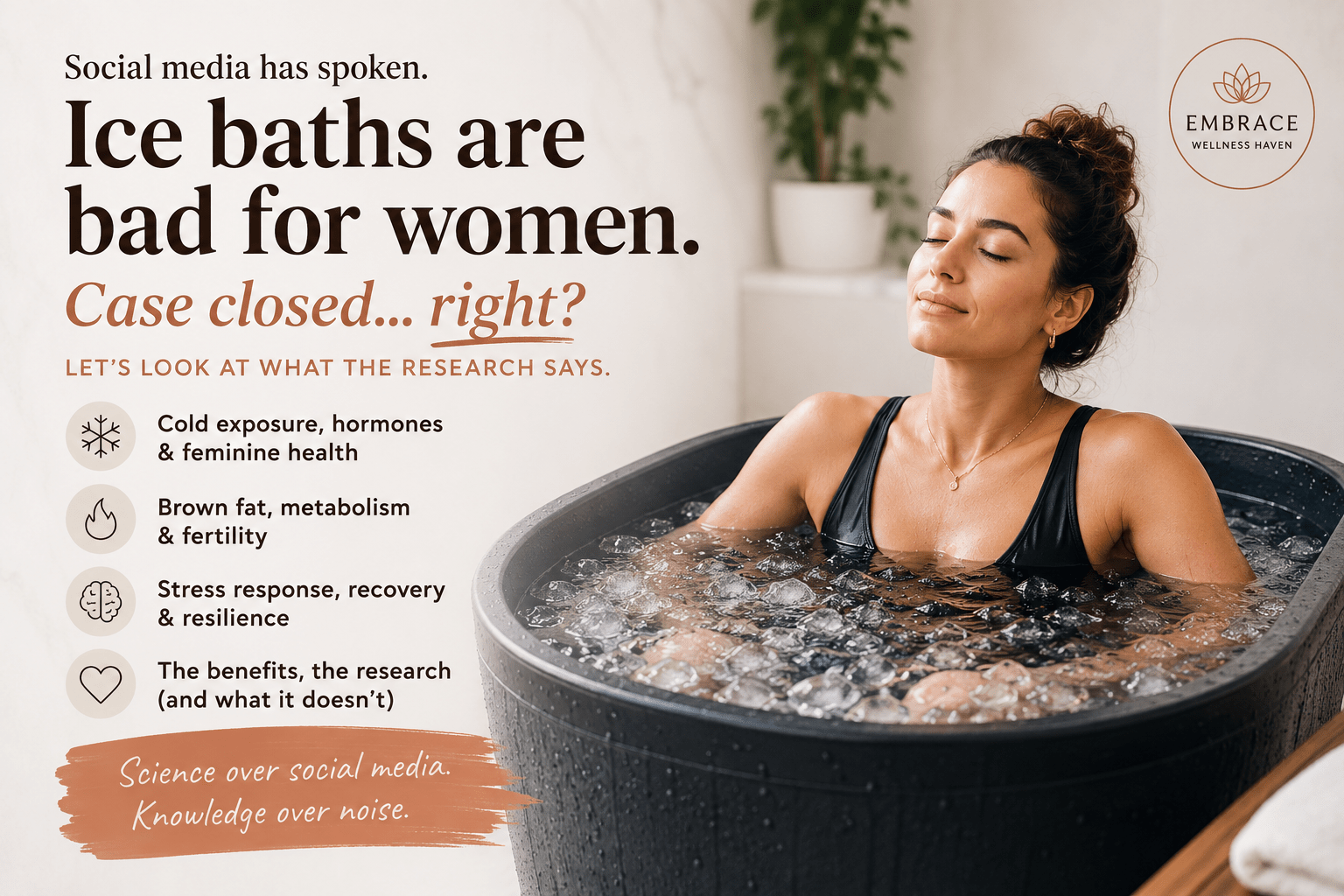
Social Media Has Spoken. Ice Baths Are Bad For Women. Case Closed... Right?
There has been a lot of noise recently claiming that ice baths are bad for women, bad for hormones, or unsafe for the female body.
Social media has spoken. Case closed. Except that science doesn't work by public vote. The best place to find answers, is not opinions or headlines.
It's the research, so before we throw the baby out with the (iced) bath water, let's look at what peer-reviewed research, human studies and some of the world's leading cold exposure researchers actually have to say. The real conversation is dose, timing, recovery and the individual woman.
Social media has spoken. Case closed. Except that science doesn't work by public vote. The best place to find answers, is not opinions or headlines.
It's the research, so before we throw the baby out with the (iced) bath water, let's look at what peer-reviewed research, human studies and some of the world's leading cold exposure researchers actually have to say. The real conversation is dose, timing, recovery and the individual woman.
First, Stress Is Not Automatically Bad
Exercise is a stressor. Fasting is a stressor. Strength training is a stressor. Even your morning coffee is a stressor.
Yet when these are used intelligently, the body can adapt and become stronger, more resilient and more metabolically flexible.
What is Homesis?
Cold exposure works through a similar principle known as hormesis. This simply means a small, controlled challenge can create a positive adaptation.
Too much stress can absolutely become harmful. But the presence of stress alone does not make something unsafe.
The question is whether the body has the capacity to adapt, and whether the exposure is controlled, sensible and appropriate.
Why Cold Exposure Can Be Especially Relevant For Women
Whether a woman is focused on fertility, athletic performance, general wellbeing, stress management, or navigating perimenopause and menopause, there is growing interest in how lifestyle interventions influence hormones, metabolism and overall health.
This is where cold exposure becomes interesting. Research into cold exposure shows it can activate brown fat, a metabolically active type of fat that helps the body generate heat by using glucose and fatty acids from the bloodstream. This matters because brown fat activation has been linked with improved energy metabolism, glucose handling and metabolic health.
Cold exposure may also support nervous system regulation. That first wave of cold creates a stress response, but with repeated controlled exposure, many people learn to breathe, regulate and recover more quickly. This is part of why people often describe feeling calmer, clearer and more resilient after cold therapy.
This is where cold exposure becomes interesting. Research into cold exposure shows it can activate brown fat, a metabolically active type of fat that helps the body generate heat by using glucose and fatty acids from the bloodstream. This matters because brown fat activation has been linked with improved energy metabolism, glucose handling and metabolic health.
Cold exposure may also support nervous system regulation. That first wave of cold creates a stress response, but with repeated controlled exposure, many people learn to breathe, regulate and recover more quickly. This is part of why people often describe feeling calmer, clearer and more resilient after cold therapy.
Could Cold Exposure Actually Support Fertility?
While there is currently no evidence that ice baths directly improve fertility, there are some fascinating biological reasons why researchers are interested in the connection.
Cold exposure activates brown fat, supports metabolic health, improves insulin sensitivity and helps regulate the body's stress response, all of which can influence reproductive health. Some emerging research has even linked conception during colder seasons with greater brown fat activity and improved metabolic health in offspring later in life.
It's an exciting area of science that highlights how closely metabolism and reproduction are connected, but more human research is needed before any conclusions can be drawn.
Cold exposure activates brown fat, supports metabolic health, improves insulin sensitivity and helps regulate the body's stress response, all of which can influence reproductive health. Some emerging research has even linked conception during colder seasons with greater brown fat activity and improved metabolic health in offspring later in life.
It's an exciting area of science that highlights how closely metabolism and reproduction are connected, but more human research is needed before any conclusions can be drawn.
Other Potential Benefits For Women
Again, while research is still evolving, controlled cold exposure has been associated with several benefits that are particularly relevant for women. The benefits include:
Metabolic health: Brown fat activation may support glucose regulation, insulin sensitivity and energy metabolism.
Dopamine and mood: Cold exposure can stimulate dopamine and noradrenaline, which are involved in motivation, focus, alertness and mood.
Stress resilience: Guided cold exposure can help train the body to stay calm during discomfort.
Sleep and recovery: When timed appropriately, many people report improved recovery, relaxation and sleep quality. •
Inflammation and swelling: Cold therapy is commonly used to support recovery and help people feel less puffy, swollen or inflamed.
Metabolic health: Brown fat activation may support glucose regulation, insulin sensitivity and energy metabolism.
Dopamine and mood: Cold exposure can stimulate dopamine and noradrenaline, which are involved in motivation, focus, alertness and mood.
Stress resilience: Guided cold exposure can help train the body to stay calm during discomfort.
Sleep and recovery: When timed appropriately, many people report improved recovery, relaxation and sleep quality. •
Inflammation and swelling: Cold therapy is commonly used to support recovery and help people feel less puffy, swollen or inflamed.
In plain English:
Cold exposure is not just about being cold. It is about teaching the body to respond to stress, then recover.
At Embrace, we use guided box breathing throughout the experience to help regulate that initial stress response. Rather than fighting the cold, clients learn how to slow their breathing, calm their nervous system and regain control. Over time, this teaches the body an incredibly valuable lesson: just because you feel stress, doesn't mean you have to stay stressed.
At Embrace, we use guided box breathing throughout the experience to help regulate that initial stress response. Rather than fighting the cold, clients learn how to slow their breathing, calm their nervous system and regain control. Over time, this teaches the body an incredibly valuable lesson: just because you feel stress, doesn't mean you have to stay stressed.
What Does Dr Susanna Søberg Say?
Dr Susanna Søberg is one of the best known researchers in cold and heat exposure. Her work focuses heavily on metabolism, brown fat, cold adaptation and the benefits of controlled exposure.
One of Dr Søberg's most interesting findings is that the benefits of cold exposure do not appear to require extreme daily exposure. Her research identified approximately 11 minutes of cold exposure per week, as being associated with beneficial metabolic adaptations. Her work also highlights the value of combining cold exposure with heat therapy, recommending approximately 57 minutes of heat exposure per week. This reflects a growing body of research around what is referred to as thermal health, using both cold and heat to support metabolic health, recovery and resilience.
The goal is not to accumulate as much cold exposure as possible. The goal is to create enough stimulus for the body to adapt, then allow recovery.
One of Dr Søberg's most interesting findings is that the benefits of cold exposure do not appear to require extreme daily exposure. Her research identified approximately 11 minutes of cold exposure per week, as being associated with beneficial metabolic adaptations. Her work also highlights the value of combining cold exposure with heat therapy, recommending approximately 57 minutes of heat exposure per week. This reflects a growing body of research around what is referred to as thermal health, using both cold and heat to support metabolic health, recovery and resilience.
The goal is not to accumulate as much cold exposure as possible. The goal is to create enough stimulus for the body to adapt, then allow recovery.
But What About The Animal Studies?
Some of the concern around cold exposure and women comes from animal studies, where researchers exposed rats and mice to repeated cold stress.
In some of these studies, changes were seen in reproductive hormones, ovarian function, reproductive cycles and uterine or ovarian tissue. These studies are important, but they need to be understood in context. One commonly referenced rat study was specifically designed to create physiological cold stress and reproductive dysfunction. The researchers were not asking whether a short guided ice bath could be beneficial. They were investigating whether repeated cold stress could create measurable reproductive changes.
Several of these studies involved repeated daily exposure over periods of 7, 14, 21 days or longer, with effects accumulating over time. The goal was to create a chronic cold-stress model, not to replicate a wellness intervention. A professionally guided Fire & Ice session at Embrace is designed around controlled exposure, box breathing, nervous system regulation and recovery. That is a very different environment from the chronic cold-stress models used in these animal studies.
In some of these studies, changes were seen in reproductive hormones, ovarian function, reproductive cycles and uterine or ovarian tissue. These studies are important, but they need to be understood in context. One commonly referenced rat study was specifically designed to create physiological cold stress and reproductive dysfunction. The researchers were not asking whether a short guided ice bath could be beneficial. They were investigating whether repeated cold stress could create measurable reproductive changes.
Several of these studies involved repeated daily exposure over periods of 7, 14, 21 days or longer, with effects accumulating over time. The goal was to create a chronic cold-stress model, not to replicate a wellness intervention. A professionally guided Fire & Ice session at Embrace is designed around controlled exposure, box breathing, nervous system regulation and recovery. That is a very different environment from the chronic cold-stress models used in these animal studies.
The Same Logic Applies To Other Stressors
If we used animal stress studies to claim all ice baths are unsafe for women, we would also need to apply this theory to fasting, strength training, high-intensity exercise, endurance sports and calorie restriction. All of these create physiological stress. Yet when used appropriately, they are often associated with improved health outcomes.
All of these can affect hormones when pushed too far. But we do not tell women to avoid exercise. We teach them how to exercise intelligently. Cold exposure should be viewed the same way.
All of these can affect hormones when pushed too far. But we do not tell women to avoid exercise. We teach them how to exercise intelligently. Cold exposure should be viewed the same way.
The Difference Is Control
There is a big difference between a professionally maintained ice bath in a safe wellness setting and pushing yourself through extreme backyard cold challenges with no guidance.
At Embrace, our goal is not to create the coldest possible experience. Our goal is to create a safe, effective and sustainable one.
At Embrace, our goal is not to create the coldest possible experience. Our goal is to create a safe, effective and sustainable one.
Our Commitment At Embrace
At Embrace Wellness Haven, our commitment is simple.
We will always put science before trends.
Social media often presents wellness as black and white. Something is either amazing or dangerous.
Real physiology is rarely that simple.
That is why we do not simply put you in an ice bath and hope for the best.
Our Fire & Ice experience is designed around the principle that more is not always better. Clients can choose between our 10°C and 3°C ice baths, however we focus on controlled exposure rather than endurance. For this reason, sessions at 3°C are limited to a maximum of three minutes, while clients using our 10°C bath are generally encouraged to aim for approximately three minutes. The goal is not to stay in as long as possible. The goal is to create enough stimulus for adaptation while maintaining a safe and positive experience.
In fact, a three-minute session at 10°C already represents a substantial cold exposure stimulus, and for many people a single visit contributes a significant proportion of the weekly cold exposure discussed in Dr Søberg's research.
Our Fire & Ice experience is designed around the principle that more is not always better. Clients can choose between our 10°C and 3°C ice baths, however we focus on controlled exposure rather than endurance. For this reason, sessions at 3°C are limited to a maximum of three minutes, while clients using our 10°C bath are generally encouraged to aim for approximately three minutes. The goal is not to stay in as long as possible. The goal is to create enough stimulus for adaptation while maintaining a safe and positive experience.
In fact, a three-minute session at 10°C already represents a substantial cold exposure stimulus, and for many people a single visit contributes a significant proportion of the weekly cold exposure discussed in Dr Søberg's research.
Why We Pair Cold With Heat
Why We Pair Cold With Heat
One of the unique aspects of our Fire & Ice experience is that cold therapy can be combined with our full-spectrum infrared sauna.
Our full-spectrum infrared sauna is designed to complement cold exposure by supporting recovery, circulation and relaxation. Emerging research has linked regular heat exposure with improvements in cardiovascular health, metabolic function, insulin sensitivity, stress resilience, sleep quality and overall wellbeing. By combining heat and cold, clients experience two powerful physiological stimuli that encourage the body to adapt, recover and become more resilient over time.
Alternating between heat and cold allows clients to experience the benefits of both therapies while creating a wellness experience that is enjoyable, sustainable and tailored to individual comfort levels. It is not about extremes. It is about education, confidence and learning how your body responds to challenge in a safe, controlled environment.
Our full-spectrum infrared sauna is designed to complement cold exposure by supporting recovery, circulation and relaxation. Emerging research has linked regular heat exposure with improvements in cardiovascular health, metabolic function, insulin sensitivity, stress resilience, sleep quality and overall wellbeing. By combining heat and cold, clients experience two powerful physiological stimuli that encourage the body to adapt, recover and become more resilient over time.
Alternating between heat and cold allows clients to experience the benefits of both therapies while creating a wellness experience that is enjoyable, sustainable and tailored to individual comfort levels. It is not about extremes. It is about education, confidence and learning how your body responds to challenge in a safe, controlled environment.
The bottom line:
The current evidence does not support the claim that sensible, controlled ice baths are harmful to women or should be viewed the same way as an extreme rodent laboratory cold-stress experiment.
Like any wellness intervention, the key is appropriate dosing, individual circumstances and professional guidance.
At Embrace, we believe informed women make the best decisions. Our role is not to tell you what to think, but to share the science, explain the evidence and provide a safe environment for you to explore what works best for your own body and circumstances.
Whether you're curious about cold exposure, looking to improve resilience, support your recovery, or simply experience something different, our team is here to guide you every step of the way.
At Embrace, we believe informed women make the best decisions. Our role is not to tell you what to think, but to share the science, explain the evidence and provide a safe environment for you to explore what works best for your own body and circumstances.
Whether you're curious about cold exposure, looking to improve resilience, support your recovery, or simply experience something different, our team is here to guide you every step of the way.
References
- Dr Susanna Søberg – The Truth About Cold Exposure, Brown Fat & Metabolism
- WHOOP Podcast – Dr Susanna Søberg on the Benefits of Cold Therapy
- Frontiers in Physiology – Cold Exposure and Brown Fat Activation
- Biomedicines – Metabolic Effects of Brown Fat Activation
- Reproductive Biology and Endocrinology – Cold Stress and Ovarian Microcirculation in Rats
- Frontiers in Genetics – Cold Exposure and Female Reproductive Function in Mice
Welcome to our blog, where we explore the latest trends and tips.
Can Ice Baths Help your Metabolism?
Cold exposure activates brown fat, a specialised tissue involved in heat production and energy expenditure.
Social Media Has Spoken. Ice Baths Are Bad For Women. Case Closed… Right?
Discover the real effects of ice baths on women’s bodies. Dive into the research that
Cortisol
What are the I’m missing? Part 1 – How Cortisol affects Peri / Menopausal women